Monday, February 29, 2016

How to utilize social media to gain new business

                                  Image credit: WireImage via @daylife

Let’s face it, seems like pretty much everyone is on social media these days and with the right tools and strategies, companies can utilize social media to increase business and build relationships. You never know when a potential customer is going to stumble upon your social media page and inquire about your products or services so it is best to provide customers with the tools they need to easily learn more about you! 60 Second Marketer (n.d.) suggests, “Every social media page your company has should direct potential customers to a landing page on your site. By looking at the analytics for that page, you can determine where your customers are coming from and how much they interact with your site once they get there.”

Social media savvy companies understand the importance of identifying these leads because they can lead to customers. One way to track these leads is to monitor your brand everywhere on the web (Cleary, 2013). You want to know who’s talking about your brand and what they are saying. “When you monitor and track keywords, you can find potential business, build relationships with new people and respond quickly to situations that could damage your brand” (Cleary, 2013).

So why is monitoring what people are saying about your brand so important? Customers who talk about your brand can hold great value to your company. “Customer Lifetime Value, in its most basic form, is the amount of revenue a typical customer will generate for your company during the customer’s engagement with the brand” (60 Second Marketer, n.d.).  This is important because it gives marketers an idea as to how much repeat business can be expected from a particular customer, which can help you determine how much to spend to “buy” that customer (Sugars, 2012).

You can estimate the CLV by plugging in your numbers into the following equation:
(Average Value of a Sale) X (Number of Repeat Transactions) X (Average Retention Time in Months or Years for a Typical Customer)

Now that you understand the importance of increasing your CLV, here are some tools that can help increase CLV. Explore some of these tools and let me know how you think they help with your SEO! I’m also always looking to try out new tools so please share any useful tools in the comments below!

       Google Alerts: the most basic of monitoring tools that can pick up mentions of your brand across the web
·     HootSuite: Allows you to monitor several social media platforms to track mentions, follows, and any other engagement with your brand.
·     Sprout Social: A tool that’s designed to help businesses grow their social media presence


References:

60 Second Marketer (n.d.). An In-Depth Guide on How to Calculate the ROI of a Social Media Campaign. Retrieved from http://60secondmarketer.com/blog/2013/11/17/in-depth-guide-calculating-social-media-roi/

Cleary, I. (2013). 3 Analytic Tools to Improve Your Social Media Performance. Retrieved from http://www.socialmediaexaminer.com/3-analytic-tools-to-improve-your-social-media-performance/


Sugars, B. (2012). How to Calculate the Lifetime Value of a Customer. Retrieved from http://www.entrepreneur.com/article/224153

Tuesday, February 23, 2016

Digitally Enlightened

Photo Source:Maker Mistaker

If it was up to my mom, I would post everything on social media. Every accomplishment, every photo of my baby, every sweet text from my fiancĂ©, and pretty much anything that would give the world a closer look into my personal life. Luckily, I’m a bit more reserved. While I do enjoy sharing photos on Instagram, Tweeting my favorite articles, and Facebooking some of my favorite memories, I do take precautions to protect my identity. I guess you could call me “Digitally Enlightened.” Morrison (2016) describes this realized user as, “a proactive individual who demonstrates heightened awareness.” This user takes caution with security threats by ensuring social media privacy settings are updated and thinks twice before sharing something on social media.

When it comes to social media, I’m mostly active on Instagram, Twitter, and Facebook. My Instagram and Facebook settings are set to private so only followers I accept can view my posts. Since my settings are set to private, I’m more open to sharing photos of my family on the platforms and only connect with friends and family. On the other hand, my Twitter is public as I use it to communicate with media (I work in PR) and other business purposes. For that reason, I’m more cautious with what I share. I’ve used the outlet to establish my personal brand. My Twitter bio gives users a glimpse of who I am and I Tweet about my interests and day to day duties in the workforce. If I get client coverage, I tweet it. If I can relate to an article I read online, I tweet it. I’ve been able to establish my personal brand by choosing to share certain information on each outlet and it has helped protect my identity.

For new social media users, I’d advise them to always ensure security settings are up to date to know exactly who they are sharing information to. I’d also recommend that users taking precautions to protect personal identify from hackers. Choose your own security questions that are hard to guess, don’t click links from an untrustworthy source, and type the address of social media sites directly into the browser (Microsoft, n.d.).

Parents should also teach kids the importance of protecting personal identity at an early age. Young kids now have access to technology and social media, making them the most vulnerable to cyber hacks. By learning how to protect themselves online at an early age, it can avoid any potential security threats.


References
Microsoft (n.d.). 11 tips for social networking safety. Retrieved from https://www.microsoft.com/en-us/security/online-privacy/social-networking.aspx


Morrison, K. (2016). Social Media Users Unwilling to Sacrifice Social Presence for Security (Infographic). Retrieved from http://www.adweek.com/socialtimes/social-media-users-unwilling-to-sacrifice-social-presence-for-security-infographic/634403

Thursday, February 11, 2016

Super Bowl Ads Get Social

This week, we examined the most talked about Super Bowl campaigns on social media. While Super Bowl ads have always appealed to marketers across the country, the transition of traditional ads to social media has been so much fun to keep up with. Scott (2015) stated, social media is a cocktail party. “The popular people on the cocktail circuit make friends. People like to do business with people they like. And they are eager to introduce their friends to each other. The same holds true in social media." (p. 58).
                                                                                     Photo Source: Quad Ale House

Many brands joined the cocktail party to promote their brands for their Super Bowl campaign. While many companies still took to traditional advertising during the game to spark the conversation, they moved the conversation over to social media platforms to engage with consumers. Twitter was the most popular marketing platform for this year’s Super Bowl campaigns so I wanted to highlight a couple of companies that took to Instagram and Snapchat to market their brand.


Walt Disney took to Instagram prior to the game to tease the trailer for The Jungle Book, which aired during #SB50. “Once the ad aired on TV, the film studio posted a link to the full trailer on its Instagram page” (Johnson, 2016). The online trailer has reached almost 2 million people since it debuted on February 7th. Search @Disneythejunglebook on Instagram for more information. 


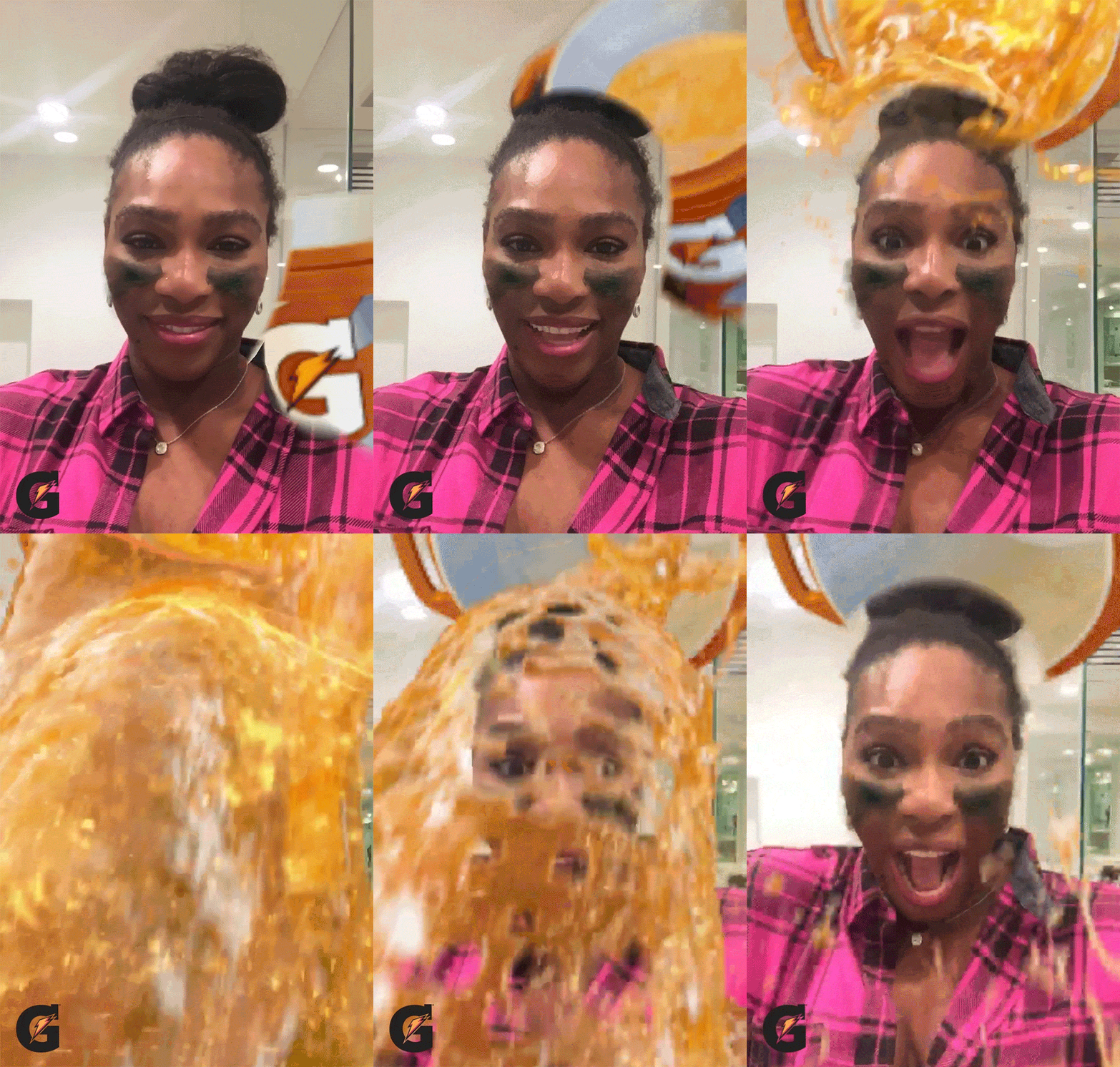
With the popularity of Snapchat on the rise, Gatorade took a unique approach to marketing by introducing a limited edition “Gatorade dunk” filter. “It wouldn't be the Super Bowl without the famous "Gatorade dunk," and this year, the brand bought a Snapchat filter showing the Big Game tradition with Serena Williams. Users can overlay it on their own posts” (Johnson, 2016).

 
                                              Photo Source: Ad Week


Brands are still in the experimental stages on how they can market their brands across various social media platforms. As new platforms continue to evolve, marketers will have to get creative on how to engage with consumers to grow strong brand communities. 

Johnson, L. (2016). 7 Brands Already Running Super Bowl Campaigns on Snapchat Before the NFL's 'Live Story' starts. Retrieved from http://www.adweek.com/news/technology/7-brands-already-running-super-bowl-campaigns-snapchat-169481

Johnson, L. (2016). 5 Super Bowl Advertisers That Nailed Their Instagram Marketing. Retrieved from http://www.adweek.com/news/technology/here-are-5-super-bowl-advertisers-nailed-their-instagram-marketing-169517


Scott, David M. (2015). The New Rules of Marketing & PR. Hoboken, New Jersey: John Wiley & Sons, Inc.

Sunday, February 7, 2016

Examining Super Bowl 50's Ad Campaigns

                                                                                    Photo Source: Forbes 

DVR and recorded programming has made made it easier than ever for buyers to skip TV ads. However with the Super Bowl being the most watched live television event, 30-second advertising spots were selling for $5 million for this year’s big game (Keeney, 2016). With the high cost of Super Bowl ads, it is important that companies target their audience appropriately.


Kerpen explains that brands should engage in conversations that are important to their target audience rather than trying to push their products. Kerpen (2015) stated, “In order to win your customers’ mindshare now, your marketing can’t be solely about your brand, or products, or features and benefits anymore. More than anything, you have to get your customers talking, or have you get involved in their already ongoing conversations” (p.47).

The Super Bowl is great opportunity for brands to get their customers talking. However, successful Super Bowl campaign can not be carried out in a 30-60 second spot. In 2013, Oreo successfully hijacked the Super Bowl by tweeting, “You can still dunk in the dark” during the game’s blackout. Oreo’s trending tweet showed companies the importance of integrating social media into their Super Bowl campaigns. “Thanks to Oreo, and the ubiquitousness of social media, Super Bowl advertisers now have to work harder to create an impact with a powerful ad coupled with tweetable moments, memorable hashtags and ads that will share well.” (Super Bowl Commercials, 2016).

Photo Source: Twitter 


In last year’s Super Bowl, 50% of advertisers created hashtags to support their campaign and that number is sure to climb this year (Super Bowl Commercials, 2016).  For this week’s discussion, choose a Super Bowl campaign that specifically stood out to you and consider the following questions:

  • Did the company follow Kerpen’s suggestion to spark a conversation with its customers by avoiding marketing a product? If so, did the company move this conversation to social media? Follow the brand on social media and see how customers are responding to the brand’s message.
  • Explain why you think the Super Bowl campaign succeeded or failed. Please provide a link or embed the commerical into your post.


References:

Keeney, T. (2016). Super Bowl Commerical 2016: How Much Does an Ad Cost? Retrieved from http://heavy.com/sports/2016/02/super-bowl-commercial-cost-2016-ad-how-much-money-expensive-value/.

Kerpen, D. (2015). Likeable social media (2nd ed.). New York : McGraw Hill Education

Super Bowl Commercials. (2016). #Hashtags Matter- Top Social Media Campaigns of SB 2015. Retrieved from http://www.superbowlcommercials2016.org/best-commercials/best-social-campaigns-super-bowl-2015/

Tuesday, February 2, 2016


                                                                                           (Photo credit: Lululemon)
“Yoga, running, goal setting & a health dose of inspiration,” (Lululemon Athetica, n.d.). Luluemon is one of the most popular athletic clothing brands right now and like many other flourishing businesses, the brand has created a blog to reach its buyers. The blog delivers content from several different authors and provide a little bit of content for everyone. At a first glance, the blog really appeals to the brand’s consumers. It’s clear they know their audience but the blog also has some weaknesses. So is the blog successful? Here’s a breakdown:

Strengths
  • Rather than saying written by staff, the name and photo of the author are seen next to each blog post. While there is no bio associated with the authors, it allows people to see the face behind the post.
  • There’s a little bit for everyone! I’m sure all Lululemon customers can find something on the blog that they would find interesting.
  • It has the look and feel of a blog- with a twist. Popular and recent posts are archived on the sidebar, along with events, and links to the brand’s social media. However, the blog looks a lot like a business and less personalized with its design.

Weaknesses
  • Comments have been disabled on all blog posts. How are readers supposed to engage with the brand? Scott (2015) describes that blogs are great marketing tool since it allows brands to listen to their buyers. This is a huge con in my opinion.
  • No About page. I feel every blog should include an About page- it can include information on the company, the writers, the blog’s polices and more.


Lululemon is not the only brand experimenting with the field of blogging but having a team of experienced communicators will help create the best experience for both brands and consumers.

I personally believe that employee run blogs can enhance a company blog. Scott (2015) explains, “Some organizations take a creative approach to blogging by saying that all blogs are personal and that opinions expressed are of the blogger, not the organization (p. 95). I agree with his stance as I think this allows readers to see the face behind the organization. The cons to this are employees may create content that doesn’t align with the values of the organization. Scott (2015) further explains that this can be avoided by implementing corporate policies on how employees should communicate. This should refer to any type of communication with the public when representing an organization.


References

Lululemon Athletica (n.d.).  Yoga, Running, Goal Setting & A Healthy Dose of Inspiration. Retrieved from http://blog.lululemon.com/?mnid=mn;blog 

Scott, David M. (2015). The New Rules of Marketing & PR. Hoboken, New Jersey: John Wiley & Sons, Inc.